
A patent protects your technical invention, such as a new or improved product, process, or device. It allows you to prevent others from simply copying your invention.
The law requires an invention to meet several criteria. First, your invention must be new, meaning it must not already be known to others. Once an invention has been publicly disclosed, it can no longer be protected. Second, your invention must be inventive: it must not be obvious. Third, your invention must be industrially applicable, meaning it can be made or used in industry.
A patent allows you to prevent others from commercially exploiting your invention. For example, your competitors may not manufacture, sell, or use your product, process, or device. This strengthens your competitive position. You can also choose to grant licenses that allow others to manufacture, sell, and/or use your product in exchange for payment.
A patent is a document describing your technical invention, supplemented by claims, drawings, or examples of the invention. The description first explains what was already known in the field of your invention. It also identifies the technical problem your invention solves. The claims specify exactly what you want to protect with the patent. A patent attorney helps you draft this application and files it with the relevant government authority. In the Netherlands, this is the Netherlands Patent Office in Rijswijk. The title of patent attorney is legally protected and can only be obtained by professionals with a technical academic background who have completed the required patent attorney training.
A Dutch patent protects your invention in the Netherlands. If you also want to protect your invention abroad, you need to file an application abroad. Once you have filed your first application in the Netherlands or elsewhere, you have twelve months to decide in which other countries you want to protect your invention. This gives you time to explore its market potential before incurring the costs of additional patent applications. You may not be ready to decide where to file further applications within that year. In that case, we can file a PCT (Patent Cooperation Treaty) application, extending the original priority year by eighteen months. You must then decide on further patent applications within thirty months.
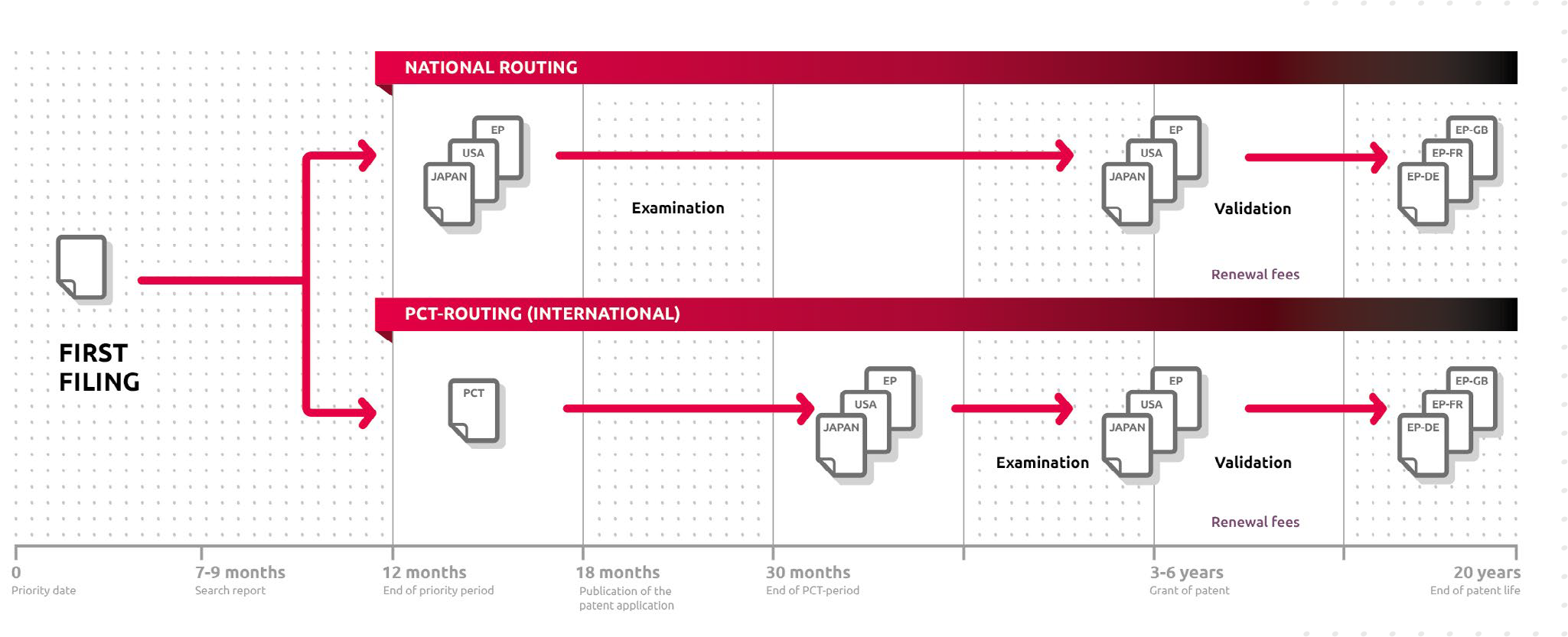
This is the date on which your patent attorney files your patent application.
This report presents the results of the prior art search. The search determines whether your invention meets the novelty requirement: your invention must not already be known to others. The patent office prepares this report, which takes up to nine months. The search report is an important source of information when deciding what to do with your first patent application during the priority year.
As mentioned, you must decide within the priority year (twelve months) in which other countries you want to file your application. The original filing date will also apply to these subsequent applications.
Every patent application is published eighteen months after filing, often together with the search report. At that point, the details of your technical invention become publicly available.
In addition to your Dutch patent application, you can file subsequent applications abroad through the PCT route. A PCT application extends the original priority year by eighteen months. You must start the PCT route within the priority year. You then have thirty months to decide in which countries to seek patent protection. The PCT application then automatically lapses.
In the Netherlands, the applicant is automatically granted a patent after eighteen months. In Europe, the United States, and Japan, for example, the patent application undergoes substantive examination based on the literature cited in the search report. After the patent is granted, an annual fee must be paid to the relevant authority to keep it in force. This renewal fee increases over time. For a European patent application, national validation is required after grant in each European country where protection is desired.
A patent is valid for a maximum of twenty years from its filing date. An exception applies to medicinal products and plant protection products: the supplementary protection certificate (SPC). For these products, you can apply for an SPC in addition to the patent. This certificate provides up to five years of additional protection for the product concerned. The duration of the certificate depends on the granting of marketing authorization for the product and the validity of the associated patent.
For more information or a no-obligation consultation, please feel free to contact us.
