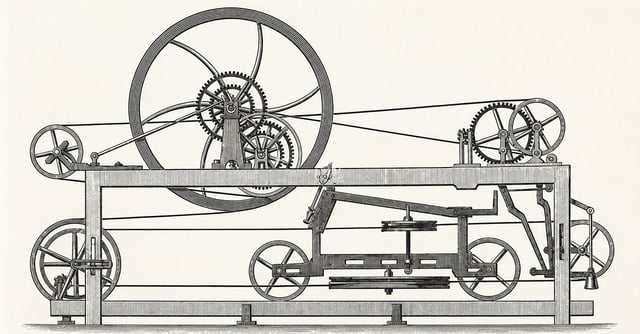
While on holiday, I was listening to the VRT MAX podcast "Napoleon" and came across the story of Belgian entrepreneur Lieven Bauwens. Bauwens smuggled one of Britain’s most valuable textile technologies to continental Europe: the spinning mule.
Its inventor, Samuel Crompton, had no patent.
The machine was based on Crompton's spinning mule, developed in 1779. It made it possible to produce stronger, finer yarn in much greater quantities and became hugely important to the British textile industry.
Crompton did not patent his invention. At the time, he simply did not have the money to pay for patent protection. Once the machine became known, other British manufacturers were therefore free to copy and improve it.
Britain took a different approach to protecting its technological advantage: the export of textile machinery and even machine parts was prohibited. Bauwens got around those restrictions by smuggling machinery to the continent.
It is an interesting contrast: Britain saw enough strategic value in the technology to prevent it from being exported, while Crompton himself had no exclusive rights over his invention.
A good reminder that the value of an invention and the ability of its inventor to capture that value are two very different things.